

Tried patience and constrained vision. Economic inflection points, assuming we’re near one, cause both. Resorting to historical lessons, though, we might say Warren Buffett is wealthy because he and Charlie Munger found patience long after everyone else’s ran out. “We have to DO something” is the investor’s and the business owner’s deadly compulsion. It has its merits, but finding something to do when there is nothing to be done can be far more damaging than sitting still when one should move.
Sitting when you are supposed to move at least has the advantage of a sort of cynical, Machiavellian virtue. Laziness will get you in the end, but until then the slothful are at least free to enjoy their idleness.
But moving when one should rest? For all your trouble and toil, you’re exactly where the sluggard wound up and without even the consolation of an interval of self-indulgence to show for it.
If there’s a reason to revisit the macroeconomic landscape, it’s the challenge of keeping our bearings when people around us seem to move according to economic calculations that are subtle beyond our understanding or are merely so stupid as to defy belief.
With the benefit of hindsight, we see that it’s almost always the latter.
We are all interested in growth of some sort. In production agriculture this usually means some combination of smartly acquired land, expanded rental arrangements with long-term landlords, and the search for specialty crops to vary rotation and more definitely reward your management more than just Monsanto’s genetics. Sure, there’s organics or asparagus or direct-to-customer-beef or Frontenac (a hardier grape that survives MN winters and against all odds, produces some drinkable wine), but for most of us, that’s a career pivot too far. If it’s merely a chase after money and not a true passionate commitment, it’s not likely to work well anyway.
So we wait as the absurdity of the calculations persists and while the stress seems greater, my forecasts so far show no broad illiquidity event looming.
So far. And perhaps now neither does anyone else.
The contrarian in me thinks that now that ’26 looks safe, we should be more alert to all hell breaking loose. We’ll know soon enough.
Bear or bull, how outlandish are the valuations and what is their history? It’s worth refreshing to bolster the patience we need & keep us sane(r) while we wait.
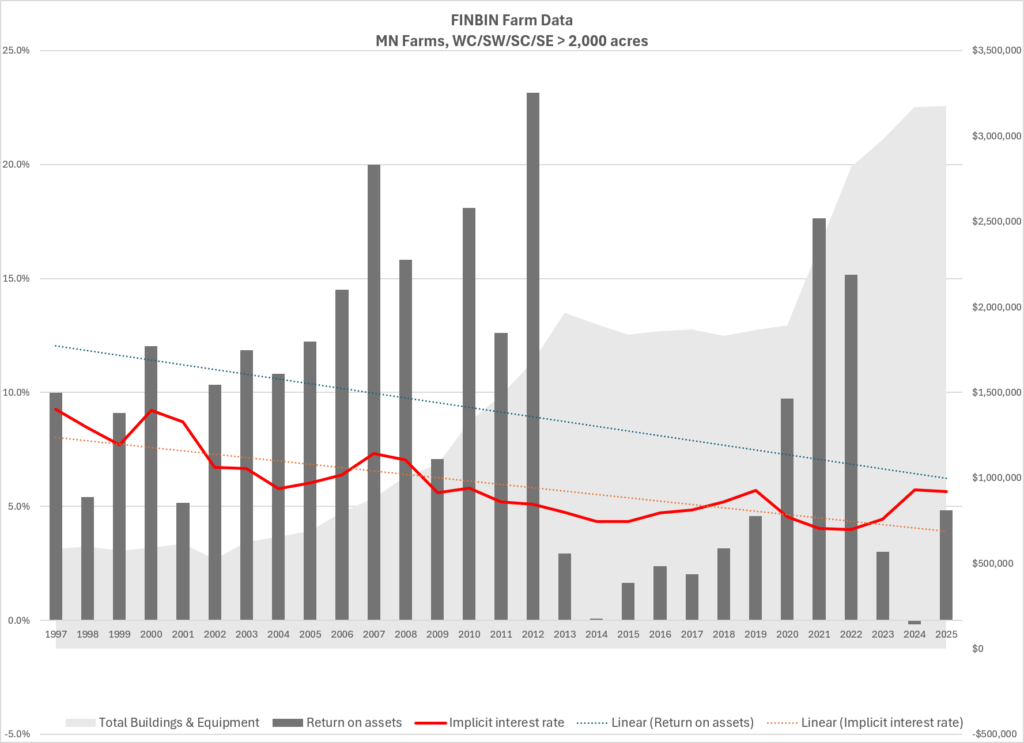
Return on assets should be higher than the cost of capital (interest rates) on average. Anything less is going broke slowly, or at least, a suboptimal deployment of wealth. These are the biggest farms in the FINPACK set so I’m not surprised to see that ROA is generally positive…it bests cost of capital 17 years of 29.
Pictured as above, the trend is shocking. Despite yields *and* prices trending upward, profit and ROA have resolutely gone the other way, and one obvious contributor is the asset footprint (excluding land). Price inflation and (likely) increasing overcapacity are the culprits. Rising inputs, too, of course. I guess I need to retract my Cantillon crack. Farmers feel the effects, and while they boost the hypothetical balance sheet values, they crunch cash flow. For growth-minded, well-run farms, this is no mixed blessing: it’s a curse.
Speaking of balance sheet effects—
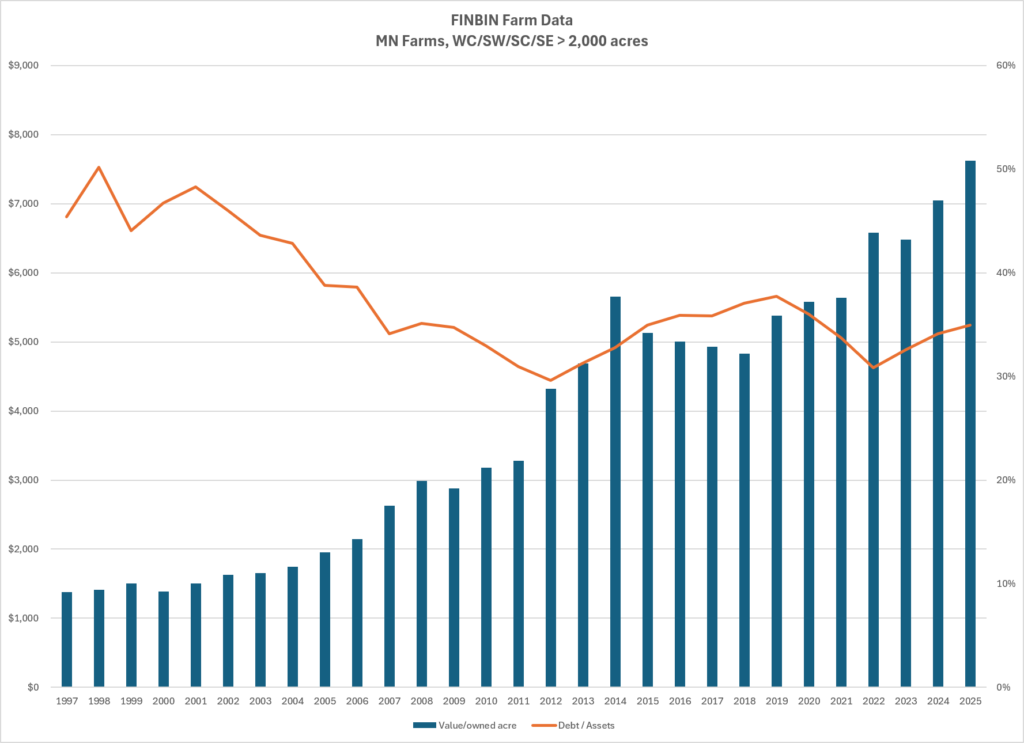
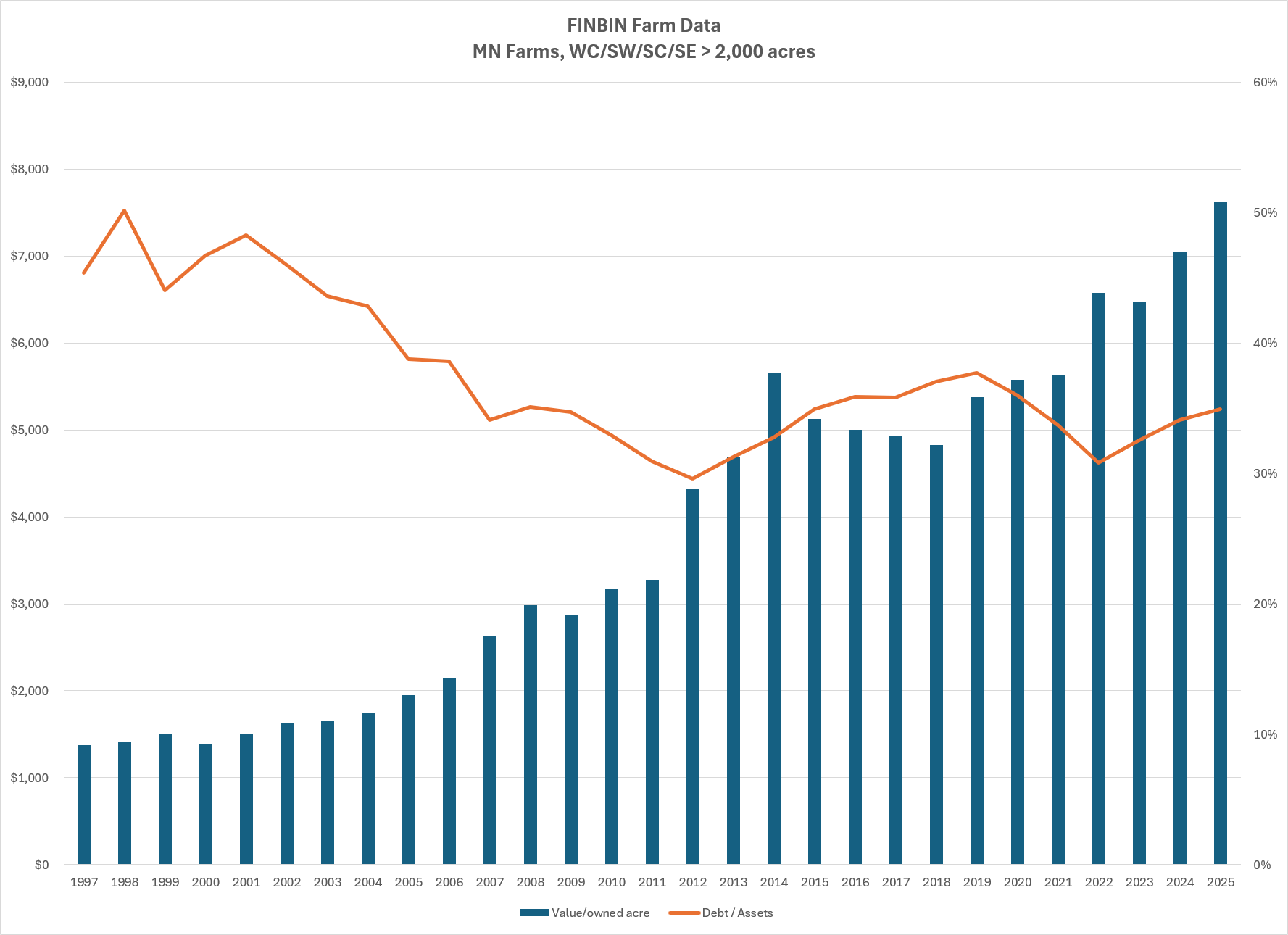
Debt to assets has moderated, and about half that is attributable to asset price increases.
Prices mismatched to value advertise for adjustment and deferral only increases the severity of the adjustment. But deferral can feel like forever. As I’ve said, paraphrasing Keynes, “Markets can remain irrational longer than we can remain sane.” That said, I think it’s important to map the mismatch in terms relevant to us.
So: using historic FINPACK data to create a hypothetical case, I look at the stated asset values, the cash, inventory and receivable balances, cost structure, and land under management. Then I set the debt to zero and shifted all land from rented to owned free and clear.
What if:
A skilled farm manager found themselves with $30,000,000 in cash free and clear, and what a coincidence, that’s the opening investment to buy 3,300 acres and the equipment needed to farm it in today’s environment. What is the ROA, given all the above assumptions?
2.26%
Or, if you will, a bit more than half what they’d earn plowing it into 6 months CDs. Talk about mismatch.
In short, land, and probably equipment and buildings, are overpriced relative to their capacity to generate income. What price would be right? Forgive me for being absurd, but just to set the lower bound, I put land values in my model to $0 and reran the ROA.
7.46%
Such an absurd input should give as absurd(ly high) output. This isn’t it. Ergo, land prices alone do not ail the farm economy. It’s the rest, too—inputs, capex overcapacity, etc.
While there is, this year, no clearly loose rock that will start a landslide, the price-value mismatch is an overhang that would take very little provocation to topple. So, somewhat frustratingly, we run our numbers, stick to plans, and mostly, wait. Success in this environment is emotionally miserable but conceptually a lower bar. Just don’t imitate the competition:
- spend 100% of operations cash on capex every year,
- grow crops on spec hoping against all evidence that the highest prices come once the crop is in, or
- buy land at these prices because it can only go up more.
Time is on our side.
Tom, Jr.